Hidden Garden: The Spring Chapter of Tiffany & Co.'s 2026 Blue Book
The “Spring” chapter of the 2026 Blue Book presents Tiffany & Co.'s fine jewelry as an exploration of nature's most intimate and unseen dimensions
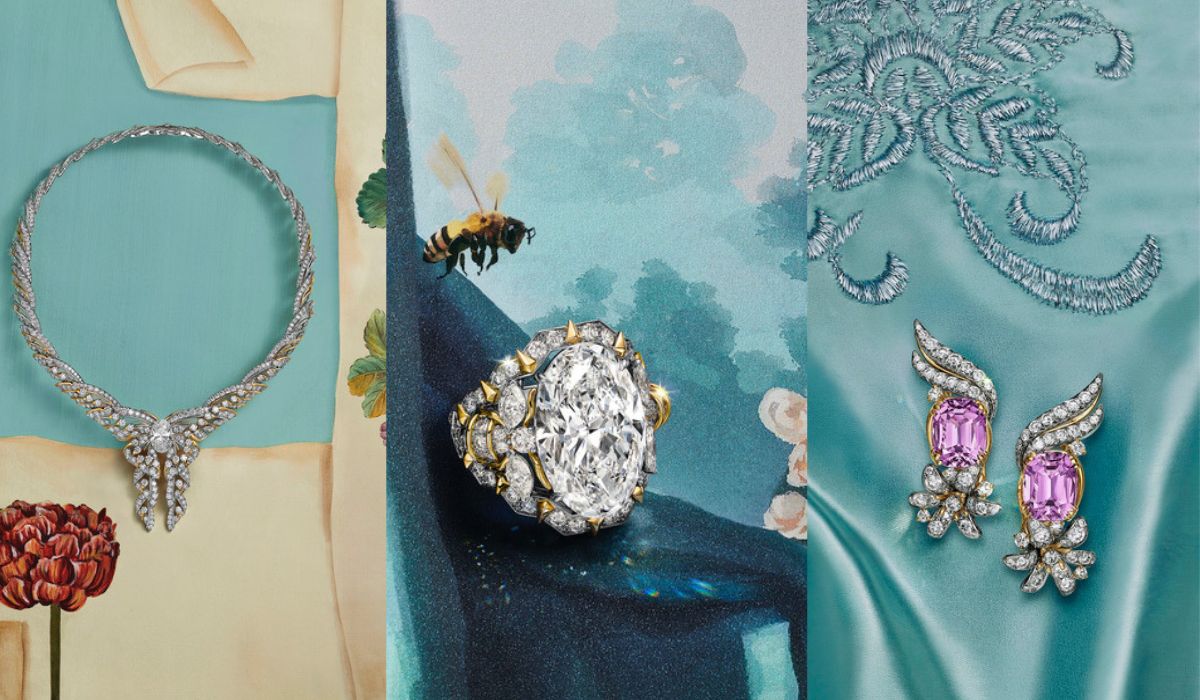
Tiffany & Co. presents Hidden Garden, the new Blue Book chapter by Nathalie Verdeille, where flora and fauna become structure, volume—light yet precise constructions—and the narrative revolves around the idea of transformation. In Butterfly, padparadscha and Montana sapphires create a palette suspended between pink-orange and cool blues, while diamonds—Fancy Vivid Yellow or white ovals—define the wings more by suggestion than description. Many pieces are transformable, but without making a point of it. Monarch revisits an archival motif, with a butterfly hidden among vines and leaves, yet here figuration recedes: what matters is the tension between material and light. Untreated sapphires from Sri Lanka and Madagascar interact with important Type IIa diamonds, in a calibrated balance between platinum and gold. Bird on a Rock returns—inevitably—but without nostalgia. Deep, saturated Santa Maria aquamarines build the visual center, while chrysoprase introduces a less predictable chromatic density. Paradise Bird and Parrot push further into color: fire opals, rubellites, paillonné enamel, and deliberately unstable pairings—emeralds with turquoise and tsavorite—that avoid any overly decorative effect. With Bee, the structure stiffens: hexagonal modules, oval diamonds, geometries that reference the honeycomb without becoming literal. The central diamond, over 10 carats, almost feels like a pretext to explore construction. Flowers are present, but without sentimentality. Jasmine is a platinum grid built around a diamond over 18 carats; Marguerite works by subtraction, breaking the flower into solids and voids; Bloom focuses on the moment just before opening, with pink and violet sapphires set in yellow gold—the collection’s only material deviation. Twin Bud and Palm close on a more controlled line: Zambian emeralds and Mozambican rubies, both untreated, are chosen more for coherence than spectacle. Diamonds serve to build rhythm and movement, not just brilliance. More than a celebration of nature, Hidden Garden operates on its abstraction: a system of forms and balances in which material remains central, without the need to declare it.